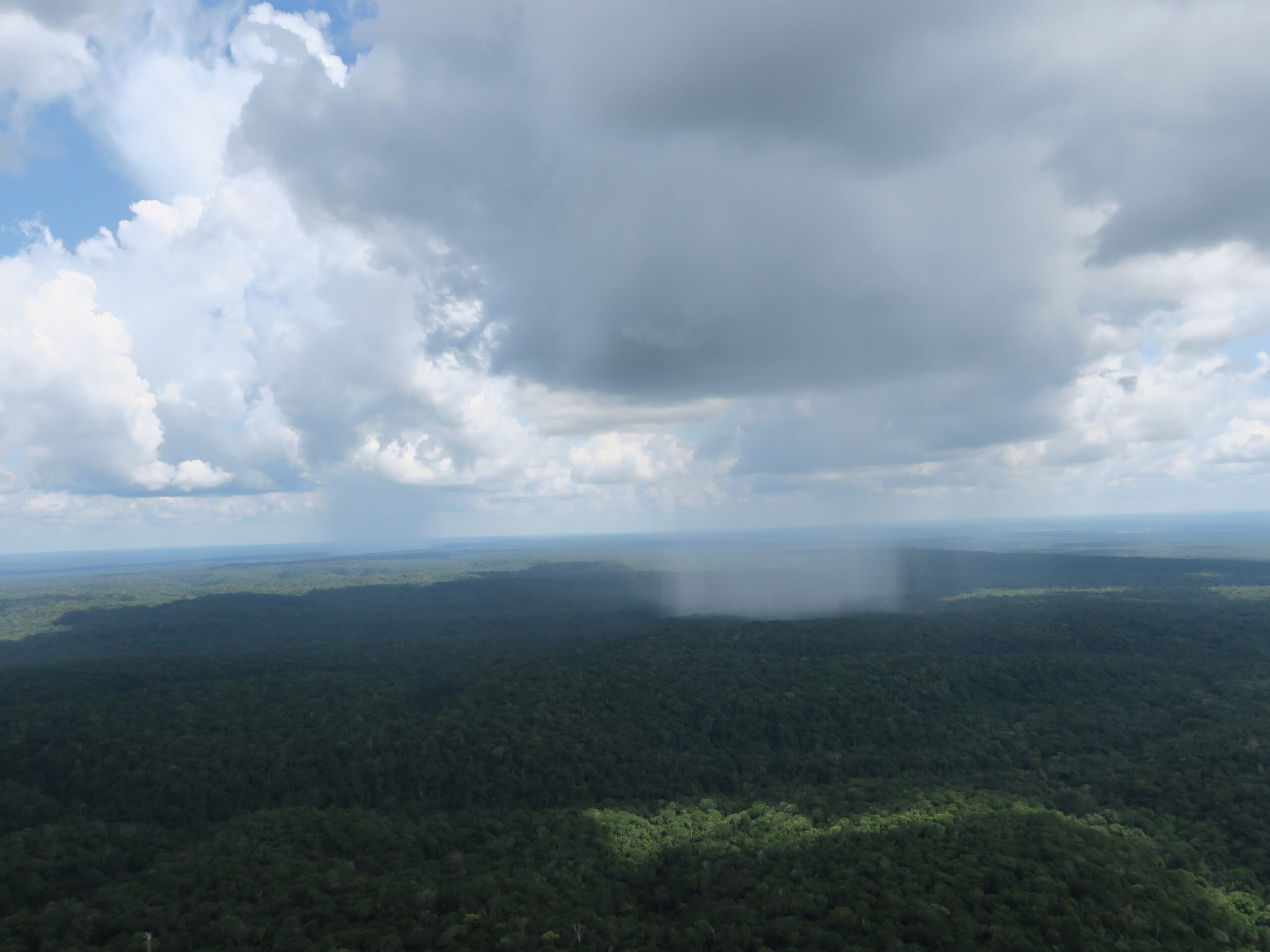
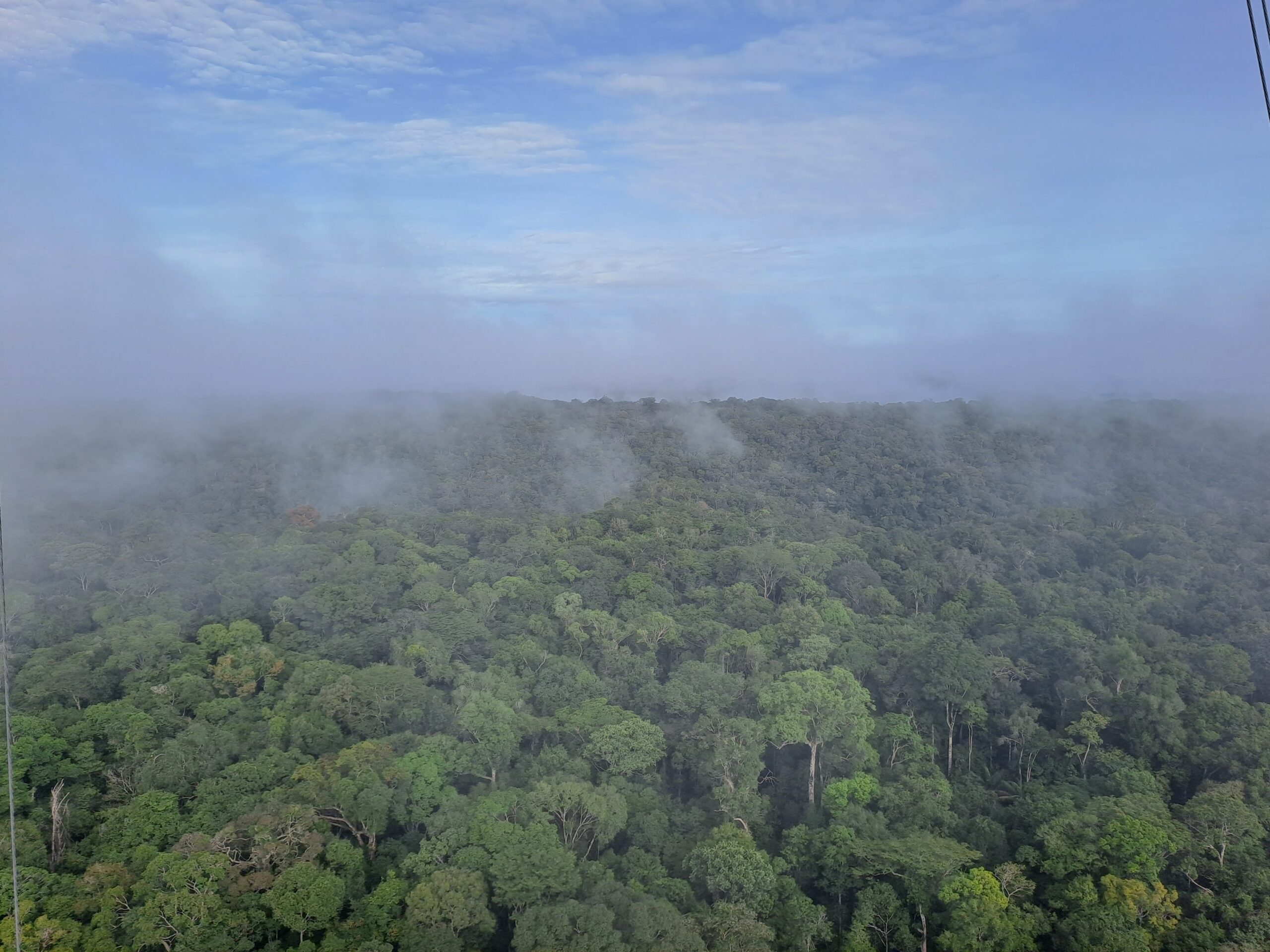
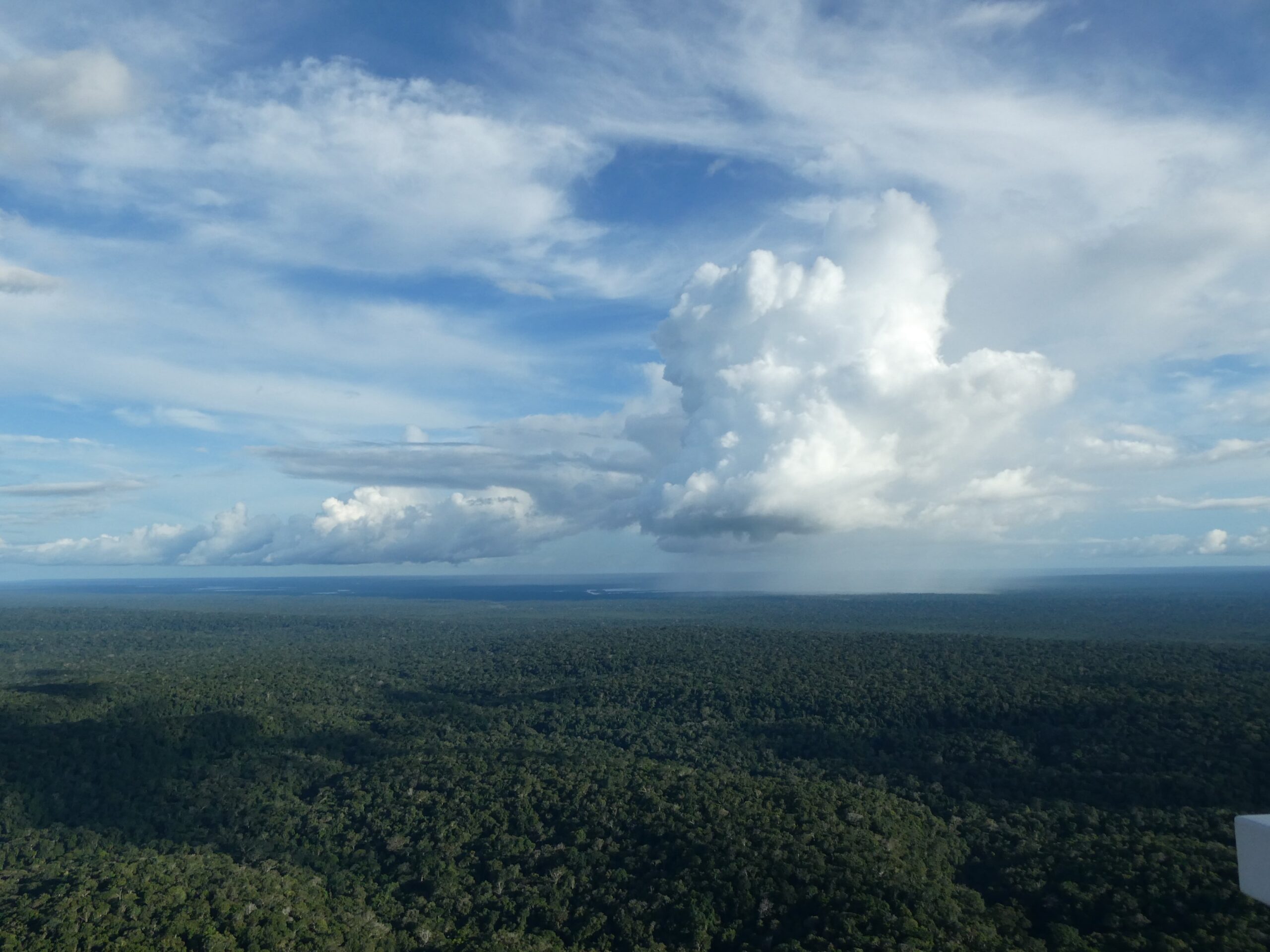
The CloudRoots project asks a simple but powerful question: How does the Amazon rainforest interact with its own clouds? In many ways, it does. Just as tree roots in the soil supply water to trees, the forest itself acts like a root for the clouds in the atmosphere. Through the tiny pores in the leaves, called stomata, trillions of leaves release water vapor into the air. Warm rising air currents, called thermals, transport this moisture upward, helping clouds to form and grow above the forest. Conversely, clouds influence the forest below by changing the amount of sunlight that reaches the canopy. This cools the plant top and affects photosynthesis and carbon uptake. CloudRoots explores this two-way dialogue between forest and atmosphere across scales ranging from tiny leaf pores to clouds several kilometers above the Amazon. The project combines meteorology, ecophysiology, soil biochemistry, atmospheric chemistry, and physics. A team of PhD students, postdoctoral researchers, technicians, and international scientists drives this truly interdisciplinary effort.
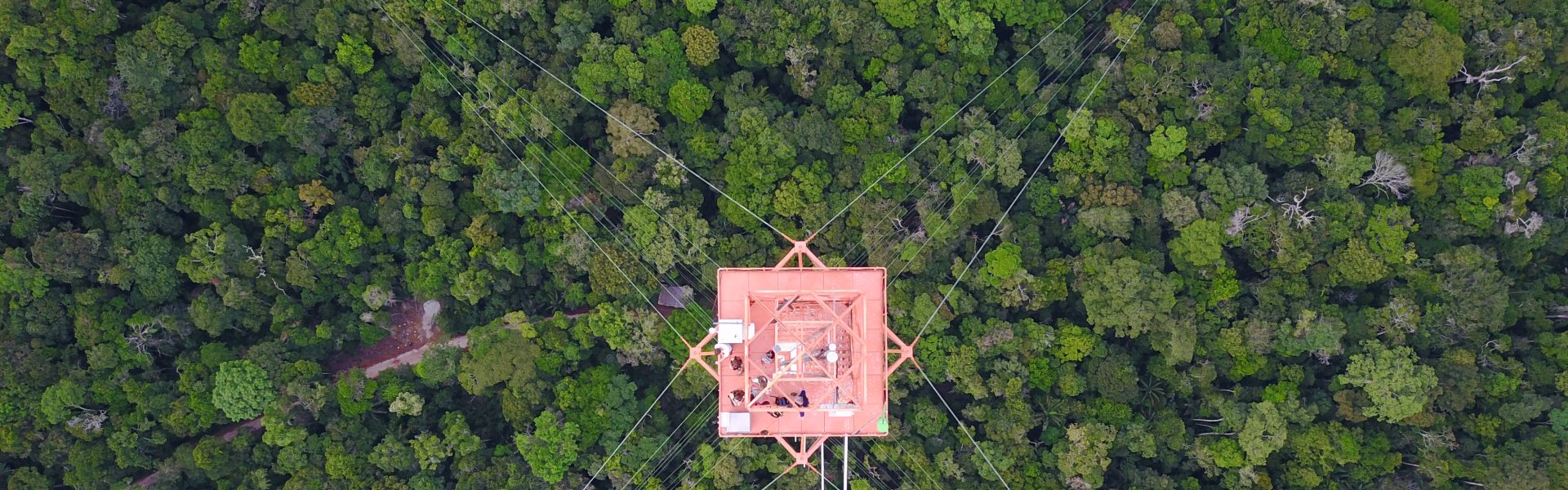
Its central field campaign took place in August 2022 during the dry season at ATTO in the central Amazon rainforest. During this campaign, scientists used advanced instruments on towers, vertical soundings with balloons, aircraft, and cloud radars. They measured how energy, water, carbon dioxide, and turbulence move between the forest and the atmosphere. A comprehensive overview of this unique campaign was presented in Vilà-Guerau de Arellano et al. (2022), demonstrating how combined observations from leaves, canopy, atmosphere, and clouds can help us better understand and represent the future of the Amazon rainforest and its role in Earth’s climate system.
Beneath the dense Amazon rainforest canopy
One CloudRoots study led by Robbert Moonen begins in the understory that sunlight barely reaches. In this dark and humid zone close to the forest floor, soils, roots, and small plants continuously release carbon dioxide and water vapor. Surprisingly, the exchange between this layer and the atmosphere above the trees is not steady or smooth. It is highly intermittent, more like a conversation happening in sudden bursts. Using extremely fast measurements taken 20 times per second above the forest canopy, the researchers discovered that gusts of wind and the passing of clouds can suddenly “flush” pockets of moist, CO2-rich air from the understory upward into the atmosphere. These turbulent ejections reveal how the forest breathes in a dynamic and irregular way.
The team combined high-frequency observations of wind, moisture and temperature with isotopic measurements. This enabled them to distinguish whether the released water vapor originated from soils or from trees themselves. This study provides a new window into how the Amazon exchanges carbon and water with the atmosphere. It shows that the rainforest does not communicate continuously with the sky, but through intermittent pulses controlled by turbulence, clouds, and sunlight.
© Jordi Vila
How forests and clouds “talk” to each other
Another study led by Raquel González-Armas focuses on the thin but crucial interface, where the dense forest canopy meets the turbulent atmosphere above. At this boundary, the exchange of carbon dioxide, water vapor, heat, and momentum changes abruptly because the forest strongly modifies turbulence, radiation (including the ratio between direct and diffuse radiation), and humidity.
The study shows that these exchanges are continuously disrupted by passing shallow cumulus clouds. They alternately enhance sunlight or suddenly shade the canopy within seconds to minutes. As a result, the stomata — the microscopic pores on leaves that regulate the uptake of CO2 and the release of water vapour — respond dynamically to rapidly changing environmental conditions. The researchers combined detailed observations inside and above the canopy with multilayer modelling. In doing so, they demonstrate that forests and clouds cannot be studied separately. Instead, they form a tightly coupled system that interacts across scales from the leaf to the atmospheric boundary layer. The variability generated by cloud enhancement, cloud shading, and canopy turbulence strongly controls the dialogue between the rainforest and the atmosphere.
Therefore, understanding how stomata open and close under fluctuating light and turbulence is essential to correctly represent rainforest carbon and water exchange in weather and climate models. Thus, it is crucial that models have high spatial and temporal resolution within the forest itself to capture this variability.
From the soil to the free troposphere
Moving upward from the forest canopy into the atmosphere, Kim Faassen and her team studied the processes that shape the daily variations of carbon dioxide and water vapour. The scientists combined aircraft and tall tower measurements in the Amazon with observations from a temperate forest in the Netherlands. To uncover the origin of the carbon, the researchers measured additional tracers such as oxygen and the carbon isotope carbon-13 (δ13CO2). These tracers act like fingerprints, helping scientists determine whether the carbon comes from soil respiration, plant activity, or air transported from far away in the atmosphere.
They found that the daytime evolution of atmospheric carbon is not controlled only by the forest itself, but also by processes that occurred far away from the surface. One of them is the exchange of air between two atmospheric layers: the atmospheric boundary layer close to the surface and the free troposphere above. These layers contain air with distinct properties, and their interactions strongly influence how carbon and moisture concentrations change during the day. Another process is the transport by clouds. Despite taking place at considerable distance from the forest, these processes have a stronger influence on the carbon evolution than the forest surface exchange itself.
The study highlights that understanding the rainforest requires viewing the forest and atmosphere as one connected system extending from the soil to the free troposphere, where clouds and atmospheric transport continuously reshape the signals emitted by the forest.
The role of clouds in the breathing of the Amazon rainforest
In Amazonia, low clouds are almost omnipresent. Yet their influence on the transport of carbon dioxide and water vapor has long remained poorly understood. A CloudRoots study led by Vincent de Feiter reveals that clouds are not merely passive atmospheric features: they actively regulate the exchange of carbon between the atmospheric boundary layer and the free troposphere. Shallow convective clouds act as atmospheric valves, transporting CO2-rich air from the forested boundary layer upward into the free troposphere. In doing so, they fundamentally reshape the vertical distribution and daily variability of carbon and moisture above the rainforest. The strength and efficiency of this transport depend not only on the surface fluxes emitted by the forest. It also depends on the thermodynamic conditions of the free troposphere, which control cloud development and vertical mixing.
The study demonstrates that an incorrect representation of cloud processes and entrainment can lead to substantial uncertainties in the simulated diurnal cycles of CO2 and H2O. These findings stress that clouds are an essential component of the forest–atmosphere system. They must be represented accurately in atmospheric and climate models to correctly describe the coupling between forests, convection, and the global water and carbon cycles.
More information on the CloudRoots project at: https://cloudroots.wur.nl/
Studies
Vilà-Guerau de Arellano et al. (2024). CloudRoots-Amazon22: Integrating Clouds with Photosynthesis by Crossing Scales. Bulletin of the American Meteorological Society.
Moonen et al. (2025). Amazon rainforest ecosystem exchange of CO₂ and H₂O through turbulent understory ejections. Atmospheric Chemistry and Physics, 25, 12197–12212.
González-Armas et al. (2025). Daytime water and CO₂ exchange within and above the Amazon rainforest. Agricultural and Forest Meteorology, 372, 110621.
Faassen et al. (2025). Tracing diurnal variations of atmospheric CO₂, O₂, and δ¹³CO₂ over a tropical and a temperate forest. Geophysical Research Letters, 52, e2025GL118016.
de Feiter et al. (2025). Turbulent exchange of CO2 in the lower tropical troposphere across clear‐to‐cloudy conditions. Journal of Geophysical Research: Atmospheres, 130, e2025JD044231.
Similar articles
A hidden mechanism continuously forms new aerosol particles from gaseous precursors in the Amazon rainforest, challenging previous assumptions about the sources of cloud condensation nuclei and their role in the hydrological cycle and climate.
Thunderstorms regularly reshape weather over the Amazon. Using high-frequency data from the Amazon Tall Tower Observatory, researchers cataloged 410 storms (Aug 2021–Dec 2023) and found they strike about every other day, mostly from midafternoon to evening and April–September. The forest canopy mutes most gusts below it, while above-canopy airflow matches textbook storm patterns—insights that improve models of energy, aerosol, and greenhouse gas exchanges for better weather and climate predictions.
New study highlights Amazon’s critical role in the Earth’s climate system, revealing that land-use changes and accelerating deforestation reduce biogenic trace gas emissions and impact atmospheric chemistry up to 12 km altitude.
Luciane Reis and her colleagues now performed a new study at the ATTO site that shows that gust fronts can also cause large jumps in carbon dioxide concentrations. But what are the sources of this carbon-dioxide-rich air?
Scientists measured carbonyl compounds in the atmosphere of the Amazon rainforest with the adopted instrumentation to separate aldehydes and ketones. They made some unexpected discoveries, showing studying the variety of carbonyl compounds separately is extremely worthwhile.
Atmospheric aerosol particles are essential for the formation of clouds and precipitation, thereby influencing the Earth’s energy budget, water cycle, and climate. However, the origin of aerosol particles in pristine air over the Amazon rainforest during the wet season is poorly understood. A new study reveals that rainfall regularly induces bursts of newly formed nanoparticles in the air above the forest canopy.
In a new study, Luca Mortarini and his colleagues introduce a novel approach to the study of the roughness sublayer, using a cospectral budget model. Its originality lies in not considering the mixing layer analogy to parameterize the turbulence statistics. In addition, it relates them to the different scales of the wind velocity spectrum without making any assumption on the property of the flow.
Eiky Moraes, Cléo Dias-Júnior and their colleagues wanted to find out if the local topography at the ATTO influenced the atmospheric movements. In particular, they were interested in the effect that topography has on the formation of gravity waves. Comparing two simulations, one with and one without topography, revealed some important differences in the dynamics and chemistry of the atmosphere.
Only when the air inside of the forest canopy mixes with the air above can there be exchange. The physical movement of the air, its turbulence, determine how well these two layers of air, the one inside the forest canopy and the one above, mix. Daniela Cava, Luca Mortarini, Cleo Quaresma and their colleagues set out to address some of these questions with two new studies that they conducted at ATTO. They wanted to define the different regimes of atmospheric turbulence or stability (Part 1) and describe the spatial and temporal scales of turbulent structures (Part 2).
In a new study, Marco A. Franco and his colleagues analyzed when and under what conditions aerosols grow to a size relevant for cloud formation. Such growth events are relatively rare in the Amazon rainforest and follow and pronounced diurnal and seasonal cycles. The majority take place during the daytime, and during the wet season. But the team also discovered a few remarkable exceptions.