FAPESP Postdoctoral project proposal
Prof. Luiz A. T. Machado is looking for a postdoc to join him at the Laboratório de Física Atmosférica – Instituto de Física da Universidade de São Paulo.
The candidate must have completed their PhD less than 7 years ago. Training or experience in the fields campaigns in Amazonia and background on meteorology, Chemistry, biology and environmental physics is desirable.
The position is open to Brazilians and foreigners. Those selected will receive a FAPESP Post-Doctoral Scholarship of R$ 12.570,00 per month and a Technical Reserve equivalent to 10% of the annual value of the grant to cover unforeseen expenses directly related to the research activity
Introduction
Amazonian New Particle Formation: Resolving the Contributions of Local Formation, Primary Biological Sources and Atmospheric Transport
Cloud droplet formation and growth depend on aerosol particles acting as cloud condensation nuclei. Aerosol can be transported from natural sources or locally produced by primary biological aerosol particles and/or by gas oxidation, clustering, and condensation to form and grow new particles (Pöschl et al, 2010, Kulmala et. al, 2004). The new particle formation process could be responsible for up to 70% of ultrafine particles. New particle formation near the surface in Boreal Forests is well understood. It strongly depends on the gaseous sulfuric acid (Kulamala et. al, 2013). However, in pristine regions such as tropical forests, where sulfate concentrations are extremely low, the mechanisms driving new particle formation remain poorly understood. These events have traditionally been attributed primarily to particle transport from the upper troposphere rather than to local formation processes (Wang et al., 2016). More recently, however, studies have shown that pristine forests can experience new particle formation following rainfall events, largely due to increases in ozone concentrations and enhanced oxidation of volatile organic compounds (Machado et al., 2024).
Multiphase chemistry is fundamental to Earth system modeling. The size threshold separating gas-phase molecules from particulate matter is approximately 1 nanometer. Atmospheric aerosols are commonly classified into nucleation, Aitken, accumulation, and coarse modes according to their size distributions. Cloud droplets typically have diameters exceeding ~10 μm. This study focuses on the features related to the transformation from gas to particle, the gas clustering processes, and condensation growing up to coagulation and scavenging and on the aerosol and cloud interaction. On a planet undergoing rapid climate change and experiencing increasing anthropogenic modification of tropical forests, it is essential to understand the physicochemical processes involved in particle formation and their subsequent growth into cloud condensation nuclei. Developing the capability to accurately represent these processes in models is crucial for understanding and predicting how tropical forests will respond to and influence global climate change.
This proposal builds on measurement campaigns at the ATTO site aimed at quantifying new particle formation arising from multiple processes. Observations will be conducted both as part of continuous measurements at ATTO and during dedicated field campaigns, including AMAZE27 (Amazon Experiment Campaign 2027) and, pending approval, ATKO (Amazon Tethered Kite Observatory). The project will further benefit from new instrumentation, such as the LIDAR system currently being acquired by ATTO-INCT.
The main objective of this post-doc project is to characterize and quantify the new particle formation in the early morning, during rain events and during stable atmosphere for the different formation processes.
Methodology
The routine measurements at ATTO and Campina, including the new Lidar, and the Two foreseen experiments will provide the basic data to answers these scientific questions
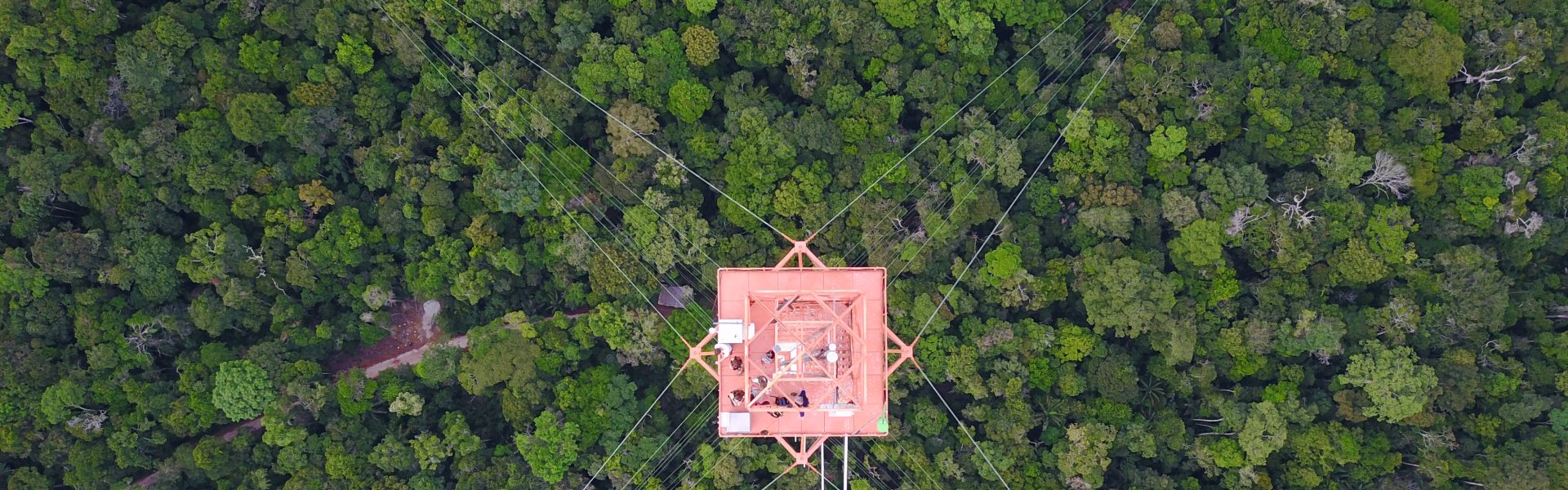
The AMAZE27 will include a series of advanced measurements and experiments designed to investigate the mechanisms of new particle formation just above the Amazon Forest canopy. The forest canopy in the ATTO region reaches heights between 30 and 40 meters, while trace gas and aerosol instrumentation are deployed along the ATTO tower from ground level up to 325 meters. For this study, two experimental chambers will be installed. The chambers will be used to test hypotheses related to particle formation in the boundary layer and to quantify the transport, local formation and primary biological aerosol particles contribution . Both chambers will be equipped with precise aerosol and trace gas instrumentation. To monitor particle number–size distributions, two Scanning Mobility Particle Sizers (SMPS, TSI)—each consisting of a Differential Mobility Analyzer (DMA) and a Condensation Particle Counter (CPC)—will be operated in parallel, one for each chamber.
Instrumentation
The following instruments are expected to be used:
- High-Resolution Time-of-Flight Mass Spectrometer (HR-ToF-AMS, Aerodyne Research Inc.). Capable of providing detailed chemical composition and mass spectra of aerosol particles in real-time.
- Proton Transfer Reaction Mass Spectrometer (PTR-MS, Ionicon Analytik). Used to measure volatile organic compounds (VOCs) in air with high sensitivity and time resolution.
- Scanning Mobility Particle Sizer (SMPS, TSI). Including, Classifier Model 308, Differential Mobility Analyzer (DMA) Model 3080, Condensation Particle Counter (CPC) Model 3787. Measures particle size distributions
- Ozone Monitor (API Teledyne, Model 400E). Continuously measures ozone concentrations.
- NOx Monitor (API Teledyne, Model T201). Monitors nitric oxide (NO) and nitrogen dioxide (NO2) concentrations.
- Nucleation Package composed by Nano SMPS, PSM, NAIS and CIMS. Monitors size distribution and chemical composition of particles routinely performed with original information of species with size from 0.1 nm to 40 nm
- Profiles from the ATKO of particles and gases.
The following measurements is scheduled to be tested:
Measurement to quantify specific contribution to New Particle Formation for raining events, stable condition and during the early morning computing:
- Horizontal transport using winds and particles gradient.
- Vertical transport using doppler sonic anemometer and SMPS in different heights
- Measure primary aerosol formation near soil and the vertical gradient using Lidar
- Measure particle formation in ambient air and control chamber setup.
- Use a VOC and ozone-enriched chamber to assess their impact.
The Pos-doc will work on the field, in the compilation, data treatment and analyses of the data to quantify the different processes in new particle formation during raining events, morning boundary layer grow, and stable days.
Your profile
- PhD in a related discipline and completed less than 7 years ago
- experience with Python programming
- Experience in data analysis
- Experience with the instrumentation referred in the project
- Training or experience in the fields campaigns in Amazonia is desirable
- background on meteorology, Chemistry, biology and environmental physics is desirable
Application
Candidates should send by e-mail to lmachado@if.usp.br
It should include:
- an up-to-date CV
- a copy of their PhD diploma
- and a letter of motivation describing previous experience and research interests.
The deadline is 05/05/2026.